
The first passenger vessel to be developed indigenously in the country for fueling hydrogen through its fuel cell is now operational on the banks of the River Ganga at Varanasi in India and will surely grow towards sustainable inland transport. This launch is meant to be one more advancement in the clean mobility journey as the introduction of alternative energy technologies gains importance in modernization efforts toward river-based transport systems.
The inland waterways are being explored as low-impact, efficient transport corridors while transitioning towards greener transit at the urban centers. Today, hydrogen-powered propulsion in passenger vessels showcases India’s emissions reduction efforts and enhances the connectivity of river networks.
A Milestone For Green Inland Waterways
The hydrogen fuel cell vessel was developed entirely domestically, indicative of India’s prowess in advanced marine engineering and clean energy integration. Before commercial service, the vessel underwent a comprehensive suite of safety assessments and trial operations to ensure compliance with regulatory requirements for inland water transport.
In keeping with the initiatives launched at the national level to promote clean energy and reduction of dependence on fossil fuels, the commissioning of this vessel is towards pathways in which India is trying to open up for river transport, introducing hydrogen propulsion to the world’s most conventional systems of diesel-fueled transport.
Project officials said they were deployed and this demonstration was also a learning exercise. It adds value to operational data that can be used to inform potential scale-up efforts of hydrogen-based mobility solutions on other navigable waters.
How Hydrogen Fuel Cell Technology Works
It is produced from a Low Temperature Proton Exchange Membrane (LT-PEM) fuel cell, which is widely hailed as the most efficient and zero-emission operating technology for the propulsion system of the vessel. The fuel cell produces electric energy by combining hydrogen and oxygen, electricity is generated to consume the vessel, emitting only water vapor as a by-product when in use.
Hydrogen fuel cells are therefore far quieter than combustion engines , and they have no exhaust emissions to pollute the air while working. Hence, they become ideal for rivers meandering through heavily populated areas, heritage zones and ecologically sensitive areas such as the ghats of Varanasi.
Hydrogen addresses increasingly valid concerns about air quality and noise pollution as they become relevant with the urban riverfront development projects.
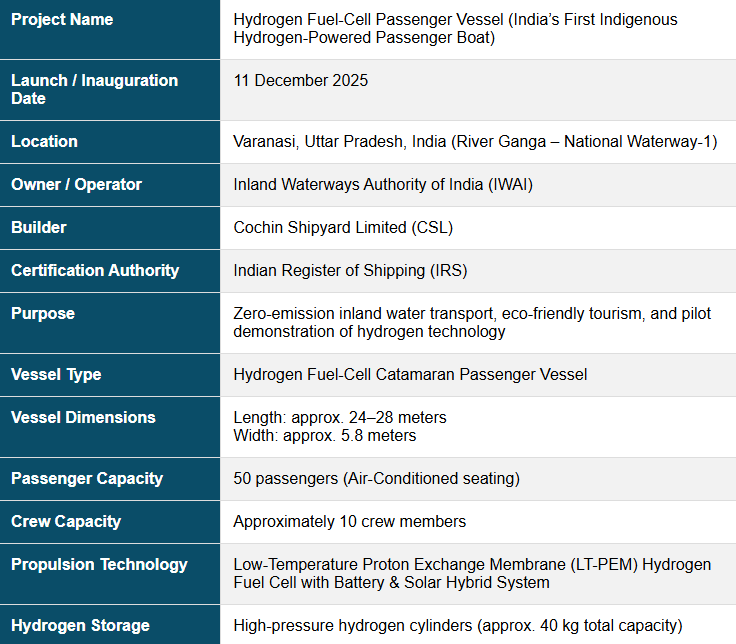
Hydrogen Fuel-Cell Passenger Vessel in Varanasi – Complete Information
Passenger And Design Characteristics
This 24 meter catamaran provides buoyancy stability and efficiency and comfort for the short runs across the river. The craft is built by Cochin Shipyard Limited and owned by Inland Waterways Authority of India-the nodal body constituted by the government for promotion and management of inland waterways across the nation.
The ship carries passengers who live and travel overland within the town, and has an air conditioned passenger cabin with room for a maximum of 50 passengers. The large windows give good river views from outside and allow a lot of natural light to come in.
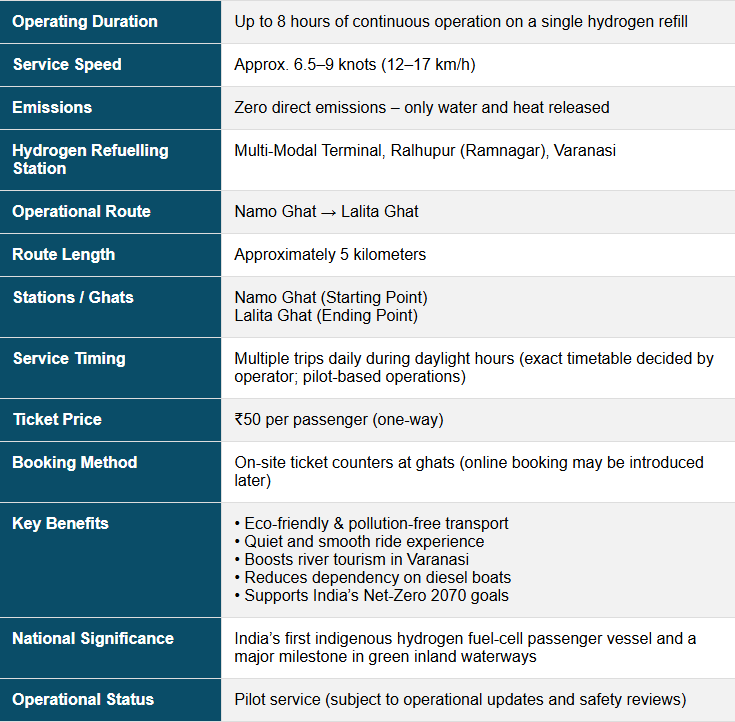
It averages about 6.5 knots in cruising speed and has been designed for short commuting purposes mostly in the city limits. The first operational stretch of the vessel covers five kilometers from Namo Ghat to Lalita Ghat, popularly used by people residing, pilgrims, and tourists.
Read More:- Varanasi Ropeway
Hybrid Energy System For Dependable Operation
One of the distinguishing features of the vessel is the hybrid energy configuration based on hydrogen fuel cells and supplemented by onboard battery availability with added renewable solar power. This overall system integration provides continuous power supply while operating and improved energy efficiency.
The batteries would hold the store energy that would be collected from the fuel cells and solar panels, enabling it to meet peak load demands and reducing the amount of fuel required. This hybrid arrangement would add a further level of redundancy to ensure the ship could be navigated safely in all operating conditions.
With one hydrogen refill, the vessel can last almost eight hours, making it ideal for daily passenger services without frequent interruptions of refueling for short times.
Safety, Certification And Regulatory Compliance
Safety has been one of the critical factors during the designing and developing of the vessel. The craft is certified by the Indian Register of Shipping (IRS) as safe, structural, and operationally realized in line with commercial inland waterway vessel requirements.
Fuel-handling hazards have been mitigated by adding multiple safety layers to onboard hydrogen storage systems that include monitoring sensors and containment mechanisms designed for enabling comparative security. Specialized training tailored toward managing hydrogen-based systems has been provided to crew members.
Implication For India Future In Clean Transport
Beyond Varanasi, the successful launch of India’s first hydrogen-powered passenger vessel opens up wider prospects for hydrogen fuel cell technology developing into a meaningful modal shift in inland water transport across the country.
India is blessed with a network of vast rivers and canals, forming a very demonstrative terrane for low-emission transport solutions. Hydrogen-powered vessels would supplement ongoing efforts to electrify certain parts of the national network, especially on routes where battery-only systems have distance or recharging limitations.
In increasing maturity of hydrogen production, storage, and refueling infrastructures, these vessels will then become more likely feasible to operate larger fleets and longer routes.
Planning For A sustainable Future Ahead: Charting A Sustainable Course Forward
The delivery of this hydrogen fuel cell passenger vessel demonstrates the marriage of clean energy technology, native manufacturing, and sustainable transportation planning. While still in its infancy, the project can be considered a practical template for introducing hydrogen propulsion into inland waterways.
With India making strides towards green mobility and alternate fuels, initiatives such as this could well shape the future of river transport — providing quieter, cleaner and more efficient travel options to passengers and at the same time decreasing the carbon footprint of urban mobility systems.
Disclaimer
This publication is designed to provide accurate and authoritative information in regard to the subject matter covered. Company names and technologies that are discussed are for informational purposes and should not be considered as investment advice. Nothing contained in these materials should be construed as financial or investment advice. Users are advised to do their own research and consult with their financial advisors prior to making investment decisions.
Investments in securities markets are subject to market risk. Please consult the related documentation in its entirety prior to making an investment.
Also Read:- International Cricket Stadium Varanasi